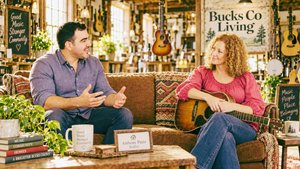
Every builder in Bucks County knows somebody in their third or fourth chapter, the person who sold one business and quietly started the next without much fanfare.
I got to sit with one of those stories in full on my show, Bucks Co Living, and it changed how I think about setbacks. Matt Freedman of Rhythm walked me through a torn knee that ended his football career, years mailing songs to Nashville publishers, a pair of golf shoes built in his garage, and a billion-dollar exit that came right after.
Here’s a preview of that episode:
Why I Had This Conversation
I have talked to a lot of guests on my show who built one good business. Matt has built four, and none of them came from the plan he started with.
As a Bucks County entrepreneur, he grew up in an athletic house here, played quarterback at Bloomsburg, and was a season away from his shot when his knee ended it in one play. What he did after that, and what he kept doing every time the next thing fell apart, is why I wanted him on.
As I mentioned when I talked about selling homes in this market, the people who last in any field are the ones who keep adjusting instead of quitting when the plan breaks, and Matt is the clearest version of that I have interviewed.
Watch the full episode here:
The Injury That Redirected Everything
Matt redshirted his freshman year at Bloomsburg so he could sit behind a senior on a winning team. He waited almost three years for his turn as starting quarterback. In a scrimmage, he tore his PCL, MCL, and meniscus on a single rollout play. The recovery took fourteen months.
He was honest about what that year actually looked like. He was not just injured. He was depressed and felt like he had let his team down at the exact moment he was supposed to be leading it.
"I really sank. I was very depressed. I mean, you had worked your entire life for that thing, and I almost felt the most like I was just letting the team down at that point. I really sank into music at that point and started writing a lot of songs, and as soon as I was back on my feet, we started touring again and playing a lot of shows with the band. So that really helped me as an outlet to kind of get through that period."
What I took from this is that the outlet you already have, even one you never planned to lean on, is usually the thing that gets you through the period when your main plan disappears.
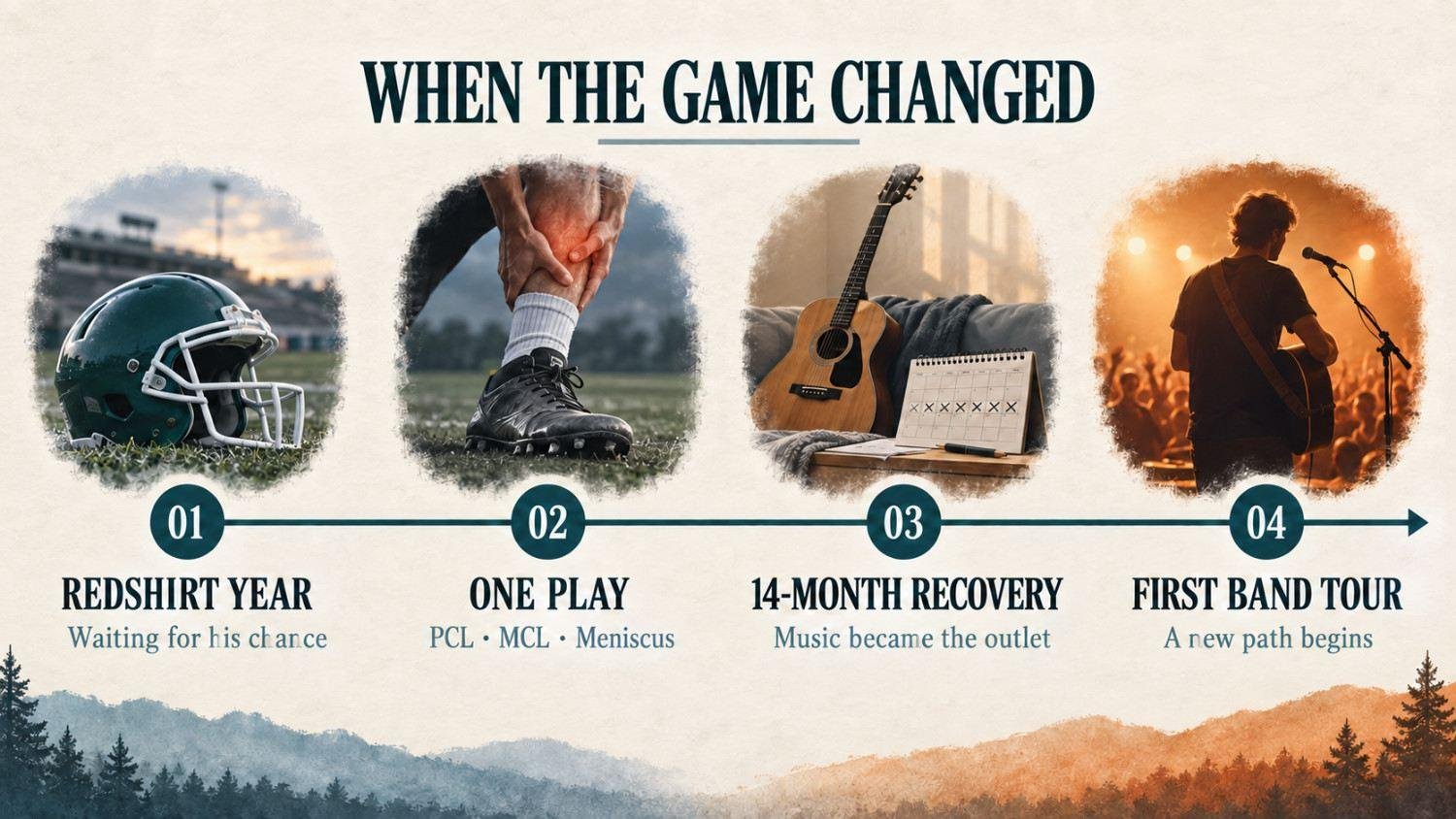
That timeline is really the hinge point for everything that came after. Without that forced pause, there is no version of Matt that spends the next decade writing songs.
Sending Songs to Nashville Until Someone Answered
Long before Rhythm existed, Matt spent years working as a country music songwriter that publishers kept passing over. His band worked day jobs and cover gigs on the side while he kept mailing songs south. Nothing happened for a long stretch. Then, one submission led to a pitch that never even landed, and that dead end still opened the door.
"I remember one of the first calls we got before I had signed a publishing deal was that there was a pitch to Keith Urban for a song that we eventually put on hold. As these things go. They just stockpile songs. We never heard back, and nothing to this day has ever happened with it. But that led to a relationship that got us our publishing deal, and the publishing deal led to a record deal and our management stuff. So it was like a fourteen-year process, overnight in the making."
That line stuck with me. Most of what looks like a fast break in someone else's career was years of unanswered submissions underneath it.
From Drill Bits to a Private Equity Exit
Matt's first real business had nothing to do with music. On an unusually warm St. Patrick's Day, he and his friends showed up to golf in loafers because none of them owned golf shoes. He drilled spikes into a pair of Sperry Top-Siders in his garage, and ten friends asked him to do the same for theirs.
That favor became forty orders, then a call to the spike manufacturer, and then a factory relationship in Taiwan. He put his last fifteen thousand dollars into three hundred pairs of shoes and sold out by Christmas.

The following year, he moved ten thousand pairs and sold the company to a private equity firm outside Boston. None of it started as a business plan. It started as a favor for ten friends who did not want wet feet.
The Talent Versus Grit Split
Two years into the startup he joined after the shoe company, Facebook acquired it for over a billion dollars, and Matt spent three and a half years inside Meta. That experience shaped how he now approaches content marketing for small business owners who assume good ideas alone are enough. When I asked him what actually separates people who make it from people who do not, he did not point to talent.
I don't care talent-wise. I'm fortunate to have a very talented team here at Rhythm for what we do, but that's the least important thing to me. I want to know the person that we can text at two AM. That gap between talent and realizing your full potential has eighty percent to do with grit and tenacity and very little to do with talent, at least to me.
This is the part I think local business owners need to hear most. Every competitor you have is talented in some way. The separation happens somewhere else.
What Changed for Me After This Conversation
Matt eventually left Meta and built Rhythm, a brand agency in New Hope. Rhythm runs on what he calls brand wellness strategy, treating a business's content, social presence, and web identity the way you would treat physical health, as one connected system rather than separate tasks. When we talked about growing your brand through content, that kind of consistency matters more than any single viral post.
"I could write a song that I think is really deeply personal, emotional, something I've felt, something I've gone through. But once I put it out there, it doesn't belong to me anymore. It belongs to you, the listener, who consumes it and then has to process it and make it resonate with them. If you really want to be helpful, then you have to take the listener or the viewer's perspective of what can add value to their life."
What changed for me is how I now think about my own business. I used to treat marketing as a task list. Matt's point about content only mattering once it means something to the other person reframed that for me. A brand is not one good post; it is showing up the same way long enough that people trust it.
Want to hear my full conversation with Matt Freedman of Rhythm on how to turn setbacks into new ventures?
Frequently Asked Questions
Who is Matt Freedman, and what does Rhythm do?
Matt is a country musician, former Meta employee, and founder of Rhythm, a New Hope-based multimedia company that builds content, social strategy, and brand identity for businesses and executives.
What is brand wellness, and why does it matter for a small business?
It is Rhythm's approach to treating a company's content, social media, and web presence as one connected system rather than isolated tasks, similar to how you would manage physical health holistically instead of one symptom at a time.
How is Matt different from a typical marketing agency owner?
Matt built and exited multiple businesses, including a shoe company and a startup acquired by Facebook, before founding Rhythm, so his approach comes from direct founder experience rather than theory alone.
Apply as a Guest on Bucks Co Living
Bucks County is full of people building second and third careers out of setbacks nobody sees from the outside. If you are running a business here and solving real problems for people in this community, I want to hear your story!
Bucks Co Living is produced by Icons of Real Estate, the #1 Real Estate Podcast Network. If you are a real estate professional, apply to be a guest speaker across the network!