You can walk into almost any room and never think twice about the floor under your feet. Then you walk into one where somebody actually made it, and something shifts.
That is the whole story behind this episode. Will Mead of Peace Valley Tile spent thirty years pressing clay and testing glazes out of a shop in New Britain. Some work is displayed in Rittenhouse Square's reflecting pool, White House lamps, and the Columbus Circle subway station.
I sat with him to discuss the meaning of handmade, what nearly sank his shop twice, and why boring work pays the bills. If you want to hear more conversations like this one, you can always browse the Bucks Co Living podcast archive.
Curious about this episode? Here's a preview of our conversation.
What Thirty Years in One Bucks County Tile Shop Actually Teaches You
I wanted to have this conversation because I drive past homes in Doylestown real estate every week that I helped sell, and I know almost nothing about who actually built the details inside them. Will Mead is one of those people, a tile artisan of Bucks County who apprenticed at the Moravian Pottery and Tile Works, the working history museum in Doylestown built by Henry Chapman Mercer, and then went out and built his own version of that legacy a few miles away.
What stood out to me most was how little of his story has to do with marketing and how much of it has to do with just doing the work well, over and over, for three decades. In 2026, expressing this is significant. Bucks County attracts artisans, and Will's shop exemplifies daily craftsmanship in Bucks County.
Watch the full episode here.
How to Tell Handmade Tile From Machine-Made Tile
I asked Will straight out whether he can tell the difference between handmade tile versus machine made tile the moment he walks into a home, and he said yes, every time. It comes down to the process. Clay arrived at his New Britain shop by the truckload from a distributor out in Pittsburgh, premixed and packed in fifty-pound bags. From there, his shop pressed most of it with a hydraulic press and hand-cut every piece, smoothing each edge by hand before it ever touched a glaze.
That single step, the hand cutting, is where the difference lives. Machine-made tile comes out of a mold in identical, repeatable units. Handmade tile carries small variations in edge, thickness, and surface that no two machines will ever reproduce the same way twice. If you want to see what that looks like up close, Will still keeps a working handmade tile catalog at Peace Valley Tile.
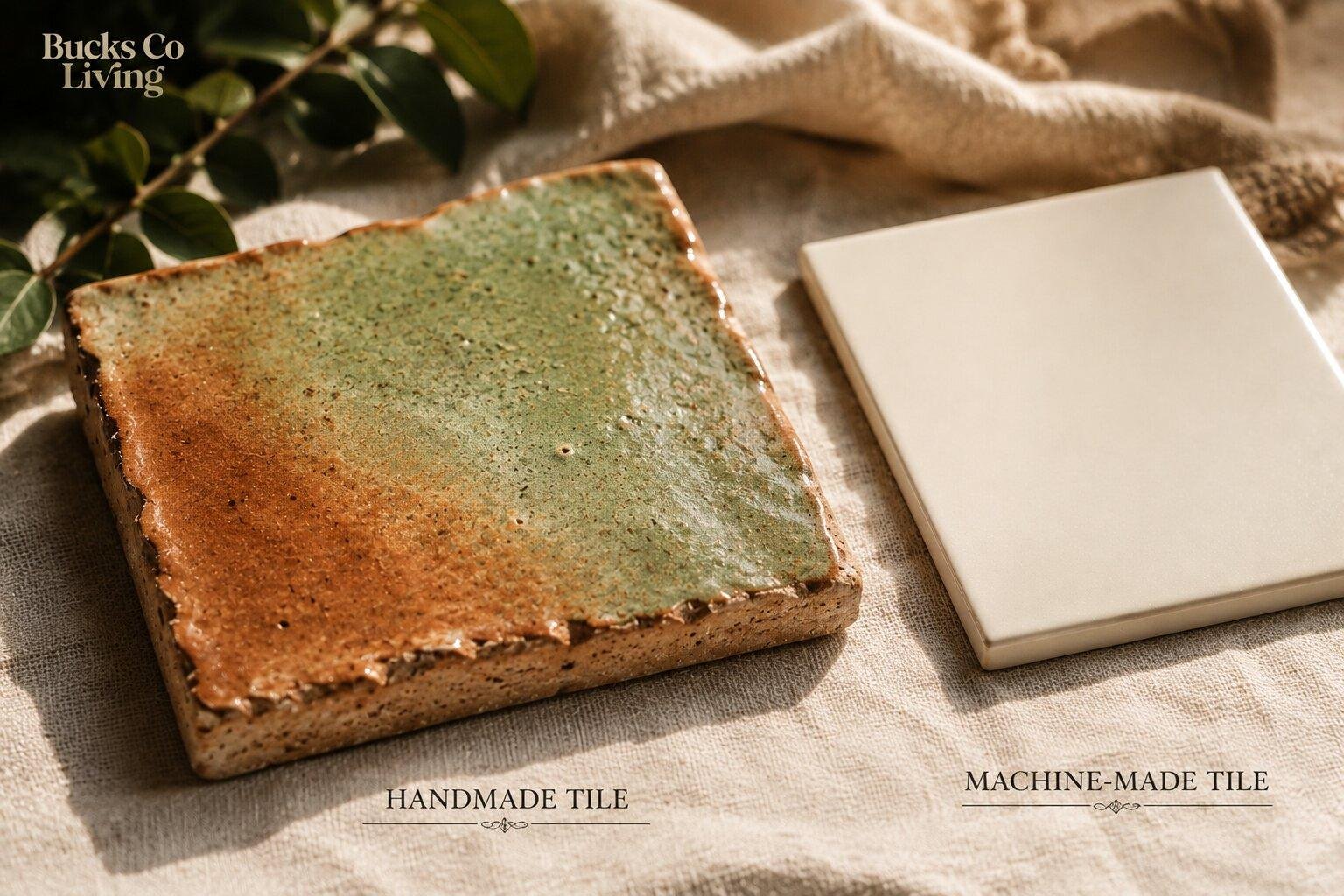
Will also got deep into glaze chemistry, which is where the real technical craft shows up. He described the whole process as science versus art, and said it is really a marriage of the two. You put weeks of work into a piece, then expose it to 2,000 degrees and hope it comes out the way you pictured it. That risk is baked into every handmade tile that leaves a real shop, and it is part of why the finished product feels different from anything stamped out at scale.
Why Word of Mouth Built a Business With No Marketing at All
Will never advertised in any real sense. No social media, no campaigns, nothing digital. His business grew because people saw his work in one home and wanted the same craftsman in theirs. He put installations into the Bucks County designer show house for a few years, and beyond that, the phone just started ringing.
"I was happily surprised that I became busy quite quickly. It was all commissioned work, so word of mouth, and I put installations into Bucks County's designer show house every year for a few years, and did some things to advertise what I was up to, and then we got busy. No social media. I don't even know how to use social media really; I'm not on it, I don't like it. We worked hard to make everything that went out of the shop be top-notch. I always ascribed to the notion that because it was just handcrafted wasn't an excuse for poor craftsmanship. It had to be well made and look good to go out of the shop. We worked hard at that, and it paid off. We did well. We had a good business."
That quote is worth sitting with if you work in real estate. Referral-based trust still outperforms almost every paid channel, and it only works if the underlying product holds up every single time. Will built a career on that principle before anyone called it a strategy. I try to build my own business in New Hope real estate and across the rest of the county the same way, one relationship at a time.
There is a real historical backbone behind why Bucks County became fertile ground for that kind of trust in craftsmanship in the first place. The American Arts and Crafts movement took hold across the country in the late nineteenth and early twentieth centuries as a direct response to mass production, and Henry Mercer's tile works became one of its most enduring American footholds. Will's work grew directly out of that lineage.
What Surviving 9/11 and 2008 Taught a Tile Craftsman About Business
A large share of Will's commission work was tied to New York City. After 9/11, building codes changed across the city and a number of architecture firms he worked with closed entirely. Then 2008 hit.
"A lot of our work was in New York City, and all the code changed in New York, and a lot of architects actually went out of business after that. And then 2008 hit; we had that recession, so we just had to work harder with less, and we got through it, but it took its toll for sure. Recessions, you learn a lot about yourself, you got to come up, you've got to get creative in a recession. We were making roof tile, we were making insulators for the insulation for electrical companies, we were doing whatever. It helped you survive."
That pivot is the part real estate agents should sit with the longest. Will did not wait out the recession hoping commission work would return. He changed what his shop produced to match what the market would actually pay for, and that decision kept the doors open.
According to the National Association of REALTORS Remodeling Impact Report, homeowners most often remodel to upgrade worn-out surfaces, finishes, and materials, which tracks closely with what Will described about how demand for handmade work rises and falls with the broader economy.
The Mistake That Nearly Cost Will Mead His Bread and Butter Work
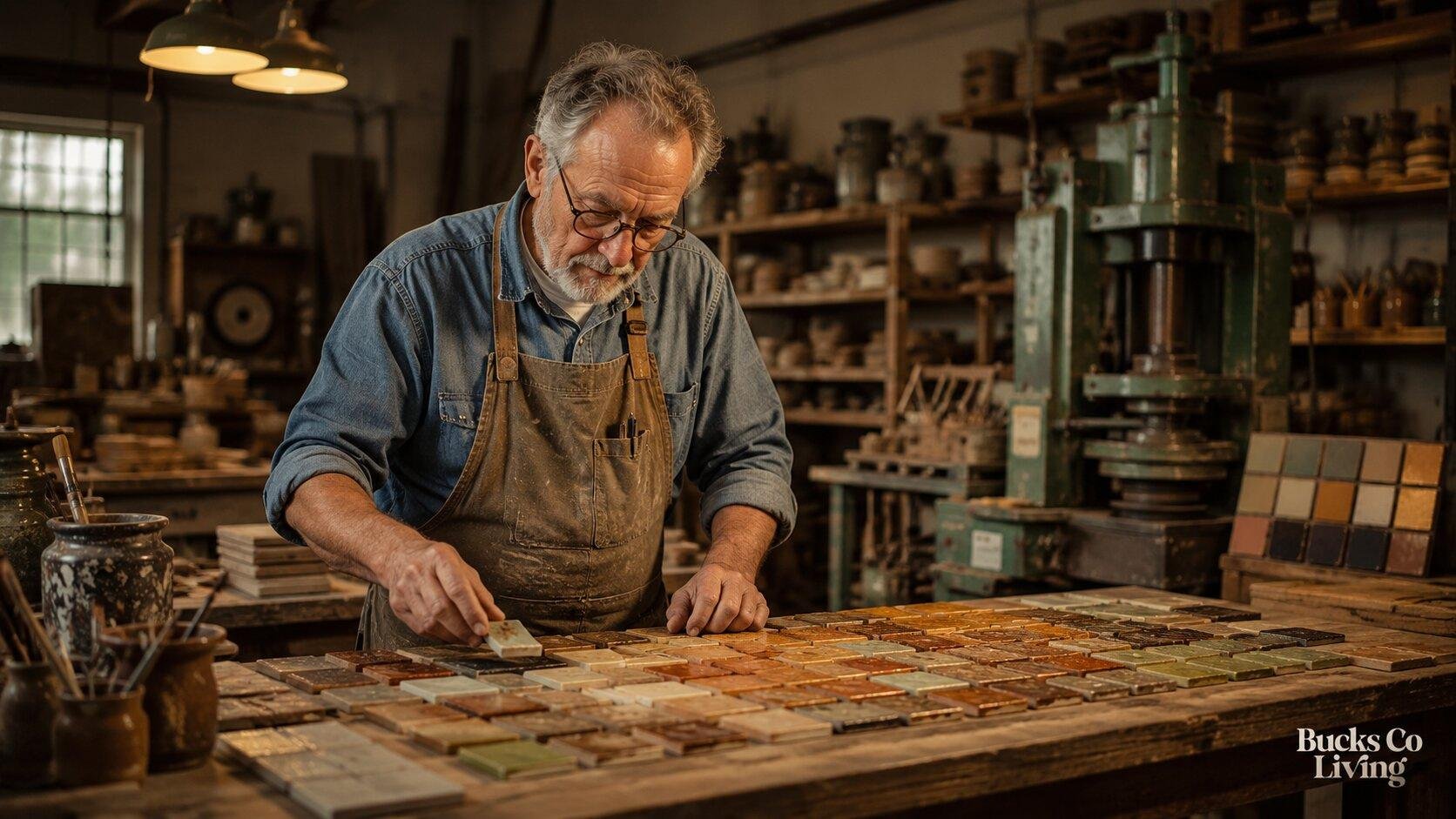
I asked Will whether, back in his busiest years, he would rather have made ten amazing pieces or a thousand average ones. His answer led straight into the one decision he called an outright mistake.
"I thought it was just the amazing pieces I wanted to do, so I stopped doing the production stuff, let go of the showrooms that were carrying our work, and that kind of thing. And that was a mistake, because all your bread-and-butter stuff is what leads to the good stuff. It was actually right before 9/11, and that's when the big commission work kind of dried up and the bread-and-butter stuff wasn't there for me so much anymore, so I had to backpedal. You have twenty average days for every three awesome days, so you've got to put up with the average days. That would be advice to a young person in the business. Don't sneer at the stuff that makes your bread and butter."
I think about this one constantly in real estate. Every agent wants the dream listing, the standout commission, the story worth telling. But it is the steady, unglamorous transactions that fund the practice and keep you in position for the big ones when they come. Will learned that lesson the hard way, and he was generous enough to hand it to us straight.

Reproducing a Color That No Longer Exists
Some of Will's most demanding work involved restoration, not new installation. The 59th Street subway station renovation in New York required matching a green matte glaze from an earlier era, using materials and equipment that had changed considerably over the decades.
He and his shop ran hundreds of glaze tests before landing on a match. That is the kind of detail that never shows up in a listing photo but explains why some tile installations hold their value and character for a century while others look dated in ten years.
Some of Will's favorite pieces came from reproducing the crystalline glazes of Fulper Pottery, based on the historic recipes of William Fulper, a contemporary of Henry Mercer whose pottery became Stangl Pottery. Will described Fulper's place in ceramic history the same way Tile Heritage Foundation, the national nonprofit archive dedicated to preserving American ceramic surfacing history, frames the broader craft: as a lineage worth documenting before it disappears.
Will is currently working with the Foundation to archive thirty years of his own shop files, a project he says has given him a different kind of appreciation for work he was too busy to reflect on while he was making it.
Want to hear my conversation with Will Mead of Peace Valley Tile about the hidden details that make Bucks County homes special? Listen to the full conversation on the Bucks Co Living podcast.
Frequently Asked Questions
How can you tell if tile is handmade or machine made?
Look for slight variation in glaze color, hand-cut edges, and surface texture. Machine-made tile is produced in identical, repeatable units, while handmade tile carries small imperfections that come from being shaped, cut, and glazed by hand one piece at a time.
What is a crystalline glaze?
A crystalline glaze grows visible crystal formations on the surface of the tile as the kiln cools. The pattern forms naturally and cannot be fully controlled, which means every piece that comes out of the kiln is genuinely one of a kind.
Where can you see Will Mead's tile work today?
His installations include the reflecting pool at Rittenhouse Square in Philadelphia, lamps at the White House, and the Columbus Circle subway station in New York. Closer to home, the Peace Valley Tile Boneyard in Pipersville is his personal archive on his own property, where visitors can pick out handmade tile in person.
If you are getting ready to sell a home with details like these worth highlighting, take a look at why homeowners choose to list with me. You can also connect with me directly on Facebook, Instagram, or LinkedIn any time.
Apply To Be A Podcast Guest On Bucks Co Living
Real estate is a business built on trust, craftsmanship, and stories worth telling. If you are working in Bucks County real estate, construction, design, or a related trade and have a story like Will's, I would love to have you on the show.
Will spent thirty years proving that steady, honest work outlasts anything flashy, and that is exactly the kind of perspective I want more of on this podcast.
Whatever corner of this industry you work in, if you have built something the same way, one relationship and one job well done at a time, I want to hear how you did it.