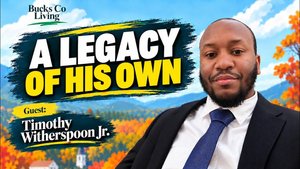
If you have spent years getting good at something, stepping away can leave you unsure where that experience belongs next. My conversation with Tim Witherspoon Jr. of Witherspoon Boxing and Fitness offered a practical way to think through that transition.
On the Bucks Co Living Podcast, I asked Tim about growing up in a boxing family, becoming a professional fighter, and building a business afterward. We discussed his Golden Gloves experience and the injuries that influenced his next chapter.
I came away with lessons I can apply beyond boxing:
How I can turn a setback into useful feedback.
How I can recognize another use for an existing skill.
How I can make learning less intimidating for beginners.
How I can connect personal experience with helping others.
Check out the highlights here:
Why I Had This Conversation With Tim Witherspoon Jr. of Witherspoon Boxing and Fitness
I had wanted Tim on the show for a long time. His family name was familiar, but I wanted to understand the person building his own business and mentoring people in Bristol.
When I asked about his childhood, he described Madison Square Garden and meeting famous fighters as regular life. At home, his father was Dad.
He also explained that difficult experiences shaped his community work and the way he treats people. That gave me a better starting point than a list of achievements: understanding what he had learned and how he uses it.
Watch the full conversation here:
His first loss helped explain that outlook.
Why I See a Loss as Information I Can Use
What I Learned From Tim’s First Loss
Tim lost his first amateur fight at eight. As he explained it, that taught him anybody could beat him, regardless of his name.
I found his later explanation especially useful. A setback gives me something to examine, provided I am willing to look at what happened.
"A lot of people hit that wall and that's it. They stop. They don't realize that hitting that wall gives them a lot of data, a lot of information to read, so the next time that they get in that position that they can do better and go past that wall. And guess what, when you pass that wall, there's gonna be another one that you have to learn lessons for." — Tim Witherspoon Jr., Former Professional Boxer and Gym Owner
How I Turn That Lesson Into Practical Questions
My application of those boxing lessons on resilience starts with a short review. After a disappointing result, I would write down:
What happened: The specific outcome, without turning it into a judgment about myself.
What I controlled: My preparation, decisions, or follow-through.
What I will change: One adjustment I can test next time.
That is my interpretation of Tim’s lesson, rather than a formal process he teaches. It gives me somewhere to begin.
His career also shows why reviewing a setback sometimes leads to a different direction.
How I Recognize the Difference Between Persistence and Changing Direction

Why I See Tim’s Career Change as a New Use for His Experience
When we discussed Tim Witherspoon Jr.’s boxing career, he described injuring his knee while training before his last fight. He fought and lost.
He also described an earlier shoulder injury that kept him out of boxing for a year. During that time, he became certified as a personal trainer.
I heard a practical opening in that story. People were willing to pay him to teach what he knew. His move into coaching, which is also documented on the Witherspoon Boxing and Fitness website, offered a way to use his experience and support his family while moving away from the injuries he associated with fighting.
What I Take From His Progression Into Gym Ownership
Tim’s business developed through smaller steps. He traveled to clients’ homes, dealt with cancellations, and worked in other gyms before opening his own space.
I see a useful sequence in his account:
| Stage I heard Tim describe | Business lesson I take from it |
|---|---|
| Teaching individual clients | Establish whether people value the skill. |
| Traveling and working elsewhere | Notice recurring obstacles. |
| Opening a gym | Build around what those experiences taught me. |
I would start by identifying one service I can deliver and learning from paying customers before committing to a larger operation.
Once Tim had his own space, the next decision was how people would feel entering it.
Why I Think Welcoming Beginners Starts Before the First Workout

How I Understand the Fear of Walking Into a Boxing Gym
For anyone considering beginner boxing in Bucks County, I think Tim addressed an important concern: walking through the door can be intimidating.
He explained that he wanted casual participants alongside competitive fighters. He also stressed that people at his gym never have to take a punch. USA Boxing makes a similar distinction with its fitness membership, which allows boxing workouts without sparring or competition.
I connected that with his account of newcomers being pushed too quickly in other gyms, getting beaten up, and never returning. His approach starts with what an individual feels able to do.
Here is how I understand the distinction:
| Concern I might bring | Approach Tim described |
|---|---|
| I will have to fight. | I never have to take a punch. |
| I will be pushed beyond my starting point. | Participation begins with individual ability. |
| The gym is only for professionals. | Everyday fitness participants belong too. |
My takeaway for anyone teaching a beginner is straightforward: I would ask about their goal before deciding what to introduce first.
Why I See the Right Location as Part of a Welcoming Business

Tim’s search for a boxing gym in Bristol, PA, also showed me that a suitable space involves working relationships.
He described finding Grundy Commons and credited the owners and landlord with helping him renovate. He also said their support during COVID mattered to the gym’s survival.
I would include those relationships in evaluating a business location, alongside the physical space. Tim’s experience shows how closely the setting and the people supporting it can connect.
That support carries into the work he does with members.
How I Connect Coaching With Community Leadership
What I Learned About Finding Success Through Others
I asked Tim whether he ever feels jealous when someone he coaches succeeds. His response was immediate: no.
He described enjoying the chance to give others what he had learned, whether they were everyday members or professional fighters. I heard someone finding purpose in passing along experience.
My practical takeaway is to make that knowledge specific. I can explain a mistake I made, demonstrate a skill, or help someone prepare for a challenge I recognize.
How I Connect Personal Experience With Community Service

That same outlook helped me understand Tim’s account of joining the Bristol Township School Board.
He said he wanted children and teachers to have what they needed to succeed. He also reflected on feeling left behind during his own schooling before later returning to complete his education.
For me, community mentorship in Bucks County becomes more concrete through that connection. Experience can help me recognize a struggle, while listening helps me understand what another person needs.
I would begin with three steps:
Identify a difficulty I understand.
Listen for where someone needs help.
Offer support within my experience and ability.
That gives me a practical way to think about contributing beyond my job title.
What Changed for Me After This Conversation
I began with questions about boxing and a recognizable family name. I finished with a broader understanding of how Tim uses what he has lived through.
Coaching, public service, and his Young Black Suburban podcast give him different ways to participate in the community. I do not need to have the same background to learn from that willingness to explore.
Near the end of our conversation, I told him that his work in Bristol was a testament to the community.
The action I take from his story is simple: identify one lesson I have earned through experience and one person who could benefit from it. That makes the idea of legacy something I can put into practice.
These answers bring the conversation back to its starting point.
FAQ Section
Who is Tim Witherspoon Jr.?
I interviewed Tim as a former professional boxer, gym owner, and son of two-time champion Tim Witherspoon. We explored his life in boxing and the coaching business he built in Bristol.
Do beginners have to spar at Witherspoon Boxing and Fitness?
Tim told me participants never have to take a punch. I highlight that because his vision includes people who want exercise and instruction without competitive fighting.
Why did Tim Witherspoon Jr. become a trainer?
I learned that injuries and opportunities to teach helped shape his transition. Training others gave him a way to use his knowledge and support his family.
Keep the Conversation Going
If you want to learn boxing, explore fitness training, or discuss coaching for yourself or your child, reach out to Timothy Witherspoon Jr.:
Website → Witherspoon Boxing and Fitness
LinkedIn → Timothy Witherspoon
Podcast → Young Black Suburban
Connect with me through my website, Facebook, Instagram, or LinkedIn.
My real estate resources include:
Apply to Be a Guest on the Bucks Co Living Podcast
My conversation with Tim brought me back to how experience becomes valuable when I put it to work for someone else. His journey from fighting to coaching shows how the lessons from one chapter can shape the next. I see that same opportunity in the businesses and community work happening across Bucks County.
If you are building a business, serving your community, or helping others through a challenge you understand, I invite you to share your story with me on the Bucks Co Living Podcast.