A cheap instrument that's never been checked by a repair tech can quietly kill someone's interest in music before they get a fair shot at it. High string action alone has turned plenty of beginners into quitters who blame themselves instead of the setup.
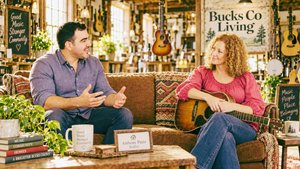
On this episode of Bucks Co Living, I talked with Kim Dieterichs of Bucks County Folk Music Shop, the second-generation owner of one of the oldest acoustic instrument stores in the country, about why proper setup changes everything and why her family's shop still feels like home to strangers who walk through the door.
Curious about this conversation? Here's a preview of our discussion.
The Farmhouse Karl and Jackie Turned Into Bucks County's Bluegrass Home Base
Kim didn't choose this business. She was born into it. Her parents, Karl and Jackie, started the Bucks County Folk Music Shop New Britain PA locals still drive out of their way for, back in 1966, and Kim grew up inside it before she ever picked up a job title. She stepped away from it in her twenties. She came back in her thirties and never left again.

The building itself has a story worth knowing too. It was an abandoned farmhouse her grandfather owned with no real plan for it. Her father, already deep into bluegrass and folk music, saw an opening. He asked to rent it. Sixty years later, that same building is still standing on Sand Road in New Britain, and it's still run by the same family.
This kind of family owned music shop history is rare, and it's part of what I wanted to dig into on the show. If you want more of the small-business stories I've covered on this podcast, other conversations I've had with Bucks County business owners dig into similar journeys.
An in-depth public radio feature on the shop's role in the region's bluegrass revival backs up just how rare this kind of longevity has become for a family-run instrument store.
Watch the full video here:
What Online Instrument Buyers Never Find Out Until It's Too Late
Here's the part of our conversation real estate agents, small business owners, or really anyone selling a product should pay attention to. Kim explained why so many beginners quit before they ever get good, and it comes down to buying instruments online vs in-store setup.
It usually isn't talent. It's setup.
"Guitars can have what's called high string action, so you have a fingerboard where you're pressing down to make chords, and then you have your strings, and sometimes those strings are higher than they should be, and now you have a new person trying to learn how to play and press down, and they're having to work so much harder. There's a band called Wilco, there's a gentleman that runs that band, Jeff Tweedy, he wrote an autobiography a couple years ago, and he has a whole section about this. So when he was about twelve, someone gave him a guitar, and unbeknownst to him the string action was high. So he started to try to learn to play, and he was like, 'Oh, this is horrible, I can't do this, it must be me,' and he put it aside, and he didn't play guitar for several years. Fast forward, he gets another guitar, it's set up properly, and he's like, 'Oh,' and he's Jeff Tweedy and he's playing amazing music."
That story stuck with me. A kid convinced himself he had no ear for music. He actually just had a badly adjusted instrument.

Kim's shop checks every instrument that comes through the door before it ever reaches a customer, beginner model or high-end, new or used. They don't charge extra for it. It's baked into the price. That single habit is why families keep driving in from New York, New Jersey, and Maryland instead of ordering online. National surveys on why learning an instrument sticks for some people and not others back up what Kim sees every day in her shop: early frustration is one of the biggest reasons people give up, and a lot of that frustration is preventable.
Choosing the right instrument for beginners isn't just about picking a price point. If you're weighing your own first purchase, the full range of guitars, banjos, mandolins, and fiddles the shop carries gives a sense of just how many entry points there are into this hobby.
Why Small Music Shops Still Beat Big-Box Stores on Trust
This is where the conversation shifted from music to something bigger. Kim talked about what her grandfather taught her, and it's advice that applies just as much to real estate as it does to instrument repair.
"Integrity is one thing that my grandfather taught me, you only get one reputation in this business. He was a realtor of all things, too. So, I didn't grow up being that, it was there, I don't think he wanted it for me, and I don't want it for my boys, but at the same time, the integrity is the biggest thing. And I think that's a testament to the small businesses. Nowadays, most cookie-cutter stores, they don't have integrity, they have numbers. They don't have patience, they don't have caring. And that's something that you guys have all in one just in a location."
I've built my own real estate career the same way. Sixteen years in, I still treat a first-time buyer with the same energy as someone selling their fifth home. Kim's shop runs on that exact principle, and it shows in how long people are willing to drive to get there.
It's the same standard I try to bring to every family I work with, whether they're buying their first home or their fifth, and it's part of why I keep showing up with a microphone instead of a for-sale sign to tell stories like Kim's.

Breaking the Bluegrass Stereotype One Customer at a Time
Bucks County isn't the first place people think of when they picture bluegrass and folk music. Kim's father changed that by showing up at festivals south of here, setting up a small vending booth, and getting to know musicians one repair job at a time. That's how he started booking acts locally, at a time when nobody expected bluegrass to have any pull in this part of Pennsylvania.
Kim also pushed back on a stereotype that's followed the genre for decades, the idea that folk music is only for one type of person. "I would say that folk music is all for hippies and bluegrass music is all for southern guys wearing their bib overalls and their straw in their mouth. And that's really not the case. I mean, people are people, and everyone shares a love of music."
This kind of folk and bluegrass music preservation is exactly what Kim's family has been quietly doing for six decades. The trade organization behind the modern bluegrass industry has spent decades working to expand that same reputation nationally, and the Smithsonian's ongoing archive of American folk recordings tells a similar story about a genre that's always been broader than the caricature suggests.
Why I'll Never Look at a Family Heirloom Instrument the Same Way Again
Kim shared something that reframed how I think about what her shop actually does. People bring in instruments that have been in their family for three generations, not to sell them, but to bring them back to life or preserve them as a memory of someone they lost.
Her definition of success ties directly back to that.
"Since success to me is integrity, I think that if we are true to who we are and treat others the way we want to be treated, that's success, right? When my parents started the shop, a friend of theirs wrote to a gentleman by the name of Pete Seeger, he was a very well-known folk musician, and Pete was the kind of guy, very personable, you could connect with him. And of course he wrote back, which was amazing. And I'm paraphrasing what he wrote in the letter, but he said to my parents, 'You're never going to be rich, you'll probably never be famous, but you are going to bring such joy and such happiness and such purpose to so many people's lives.' And that's the motto that I live by, and to me that is success."
That's not a bad way to measure a business, in music or in real estate. You can check the shop's ongoing lesson programs across banjo, guitar, fiddle, and mandolin, or follow along with what's new at the store on their Facebook page and Instagram. Kim is also on LinkedIn if you want to connect with her directly.
Want to hear my entire conversation with Kim Dieterichs of Bucks County Folk Music Shop, the second-generation owner of Bucks County Folk Music Shop, about why a properly set up instrument can be the difference between a lifelong passion and a beginner giving up? Listen to our podcast episode!
FAQ Section
What makes Bucks County Folk Music Shop different from buying an instrument online?
Every instrument that comes through the door, new, used, beginner, or high-end, goes to the repair shop first to be checked and adjusted before it's ever sold, at no extra charge.
How long has Bucks County Folk Music Shop been in business?
The shop was founded by Kim Dieterichs' parents in 1966 in New Britain, Pennsylvania, and has been run by the same family for 60 years.
Does Bucks County Folk Music Shop offer music lessons?
Yes. The shop offers lessons in clawhammer and bluegrass banjo, fiddle, guitar, mandolin, and ukulele through a team of experienced teachers.
Apply To Be A Podcast Guest on Bucks Co Living
Bucks County is full of stories like Kim's: small businesses, families, and community builders who don't always get the spotlight they deserve. If you're doing meaningful work in this area and have a story worth sharing, apply to be a guest on the show.
Conversations like this one are exactly why I started this podcast: not to chase big names, but to put a mic in front of the people quietly holding this county together. Whether you're running a shop, a nonprofit, or a passion project nobody's written about yet, I want to hear what you've built and why it matters to the people around you.