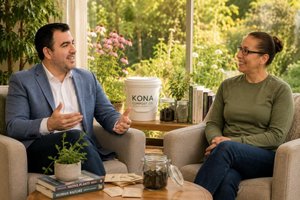
Scaling a multi-generational family business through strategic relocation and old-school customer service is not for the faint of heart. Most business advisors will tell you that moving two established retail locations within a single year is absolute madness.
In the recent episode of Bucks Co Living, I had the privilege to talk to Michael Kanoff of Michaels Jewelers. He looked at a 50-year family legacy and decided the only way to protect it was to reinvent its physical footprint. He proved that respecting your roots and ripping up the old playbook are not mutually exclusive.
Here’s a preview of our conversation:
I had a personal reason to want this conversation: one year ago to the day we recorded, I got engaged to my wife, Kelly, using a ring crafted by Michael's team.
Experiencing his high-touch customer framework firsthand made me realize how rare true, high-caliber service is in our modern, automated world.
Listen to the full episode:
Why I Wanted to Bring This Multi-Generational Growth Story to Our Community
As a local business owner, I am fascinated by legacy, longevity, and calculated evolution. Experiencing Michael's high-touch service firsthand made me realize how rare true craftsmanship has become in our automated world. This conversation matters for any professional who feels capped by their current location or stuck in traditional ways of operating.
Michael is a fourth-generation jeweler and a prime example of Bucks County small business growth. His father broke into retail, and with help from his grandfather, opened the original Michaels Jewelers in Fairless Hills Shopping Center in 1976.
For Michael, there was never a plan B, and his approach to multi-generational family business transition offers a roadmap for any legacy brand. The reasons buyers still choose independent shops are well documented, and recent shopping local statistics show 68% of every dollar spent at a local store stays in the local economy, which is the kind of community equity Michael has spent a career building.
Finding Your Independent Edge: From Wholesale Insights to Retail Mastery
Before taking the reins, Michael took an intentional detour. He studied at the Gemological Institute of America in California, graduated as a certified gemologist, then worked wholesale diamond circuits in Los Angeles before relocating to Atlanta to sell to independent storefronts across the Southeast.
That period was his real education. By auditing hundreds of retail stores, he learned a hard truth:
businesses that fail to evolve their presentation and client onboarding get choked out by larger corporate entities.
When his father called in 1997 about a new location in Yardley, Michael Kanoff from Michaels Jewelers brought a nationwide perspective back to a hyper-local market. That blend of fresh and local mirrors what I see every day in real estate, and it is the same instinct I bring to clients navigating the Bucks County market.
Mapping the Career Blueprint of a Legacy Operator
| Career Phase | Core Operational Objective | Key Insight Realized |
|---|---|---|
| GIA & LA Diamond District | Technical mastery and foundational grading | Learned how supply chains impact retail pricing margins |
| Southeast Wholesale Circuit | Auditing diverse retail storefronts | Identified what set successful independent stores apart from failing ones |
| Retail Repatriation (1997) | Merging family equity with modern systems | Proved that local heritage must be paired with aggressive experiential retail |
The Audacity of Expansion: Why Moving Two Thriving Stores in One Year Was a Critical Risk
Most advisors would call moving two established locations a reckless move, but Michael's retail store relocation strategy was calculated and deliberate. But the story of Michael Kanoff managing Michaels Jewelers through a volatile market is a study in reading traffic over nostalgia.
His Fairless Hills store carried a 50-year legacy, yet Michael saw the location had hit a definitive growth ceiling. Walk-by traffic was non-existent, and the space could not hold his vision for an immersive bridal boutique.
He explained the trade-off between sentiment and hard commercial metrics in his own words:
"A lot of it was, 'Gee, I love it here 'cause it's home. We've been there for so long, it's our original.' But truth be told, our business was not gonna grow staying there. It was, I feel like it just reached a level that was capped. There was zero walk-by traffic in that center. I always thought, 'This center's booming. There's tons of traffic. It's the opposite. There's tons of walk-by traffic, drive. The center's always nuts.' And every time I would pull into that center, it could be night, it could be morning, I'm always in awe of, 'Look at all the cars. Look at all the traffic.' I love it. So I finally figured, normal people don't move two stores within a year, but opportunity knocked, and I thought, 'As long as my wife doesn't kill me, I'm gonna do it.'"
Despite the community's emotional attachment, Michael scouted high-visibility corridors in Yardley by the new Wegmans development and at Langhorne Square. He negotiated terms, coordinated construction, and executed a double relocation that instantly multiplied his daily brand impressions and walk-in traffic.
For anyone analyzing a commercial space, the lesson is plain: foot traffic and visibility drive revenue, a principle that holds whether you sell engagement rings or list homes, and one I unpack often in my work on local market trends and relocation.

Weaponizing Old-School Customer Experience Against Corporate Automation
We live in an era of self-serve kiosks, but Michael has turned independent retail customer experience into his secret weapon. Michael's strategy for dominating his market is simple but radical: double down on un-automatable human sincerity. Walk into one of his custom showrooms and you are not a transaction.
His staff learns the love stories behind every engagement ring and the family history behind every anniversary piece. The data backs the instinct, since a recent local economy report found 56% of consumers say knowledgeable, attentive staff make a small business memorable.
He framed his anti-commodity blueprint clearly:
"The main thing that keeps us standing apart is our service. 'Cause the one thing I feel like it's lost, in this day and age, there is no service. You walk into Home Depot, there's no cashiers. It's all robots and self-serve, and I'm like, 'No.' I'm like, 'We have to keep the old school service 'cause people just don't do that anymore.' And realize that, people can go anywhere, but they can't get the experience that we can provide. That's why we've gotta stand out and make sure we give that to them every single time. It's the personal relationships I have with people that are my favorite part. There's so many people in the community that I've known over the years. You can't fake sincerity. You know what I mean?"
Cultivating an Un-Copyable Team Culture
To deliver this across two stores, Michael hires for personality over resume boxes. He brings in young, energetic talent who run modern campaigns, proving that effective community business marketing blends digital trends with genuine local connection. By protecting veterans and empowering new hires, he has built a resilient retail culture. He also embraced lab-grown diamonds for bridal buyers, a category that fits where younger shoppers are heading, since the U.S. lab-grown diamond market is projected to expand sharply through the early 2030s.
Navigating the Brutal Realities of a Retail Buildout
The finished showrooms look effortless, but the reality behind the scenes was stressful. For Langhorne Square, Michael acted as his own general contractor and subcontractor coordinator. He collided with global logistics when his custom showcases, manufactured in Turkey, hit months of unexpected customs delays.

Carrying rent and salaries with zero revenue through a closed storefront is an operational nightmare.
Michael's point is direct: to survive aggressive expansion, you need deep cash reserves and a high tolerance for chaos. The store opened about ten days late. That experience also sealed his decision to cap his footprint at two powerhouse locations rather than dilute focus with a third. You can see both finished stores on his store locations page.
My Core Realizations After Deconstructing Michael's Business Evolution
This conversation shifted how I view my own market presence. It is easy to get comfortable with a steady stream of business and a strong reputation, but comfort is the first step toward obsolescence. Michael showed me that if your infrastructure caps your growth, you need the courage to dismantle it, even if it means leaving a 50-year comfort zone.
He also reframed what endurance actually requires:
"The first 25 years of my career, I was locked in here store hours, 24/7. That can burn you out. Whereas now we are staffed properly. I can come and go. I work hard, but I play hard also too. So I think doing that good work-life balance, I'll never hate this. I'll always love this, and I don't know, there'll never be a time where I won't wanna be here. As long as I love doing it, I'm gonna work till I drop dead. I'm dead serious about that. There are jewelers I know that still work in their 80s. They don't work full-time, but they come and go as they please. They've got a good staff or possibly family on hand that they can do that."
True business success is not just total revenue. It is building a self-sustaining ecosystem. By hiring exceptional people, empowering them to manage clients independently, and balancing hard work with unplugged time at his beach house in Margate, Michael built a business that fuels his life instead of consuming it. That is the goal for any entrepreneur, and it is why community-rooted operators continue to outperform; independent retailers return up to three times more money per dollar of sales to the local economy than chains.

Want to hear my entire conversation with Michael Kanoff about moving two jewelry stores in one year, keeping old-school service alive, and building a four-generation legacy in Bucks County? Listen to our podcast episode!
Frequently Asked Questions
How do you know when a business location has reached its growth ceiling?
A location has peaked when revenue plateaus despite increased marketing spend, and your physical footprint lacks the space for modern experiential upgrades. Low organic foot traffic or poor drive-by visibility also artificially restrict your growth.
How can a traditional retail business attract a younger demographic?
Integrate younger team members into your marketing and give them creative freedom on platforms like TikTok and Instagram. Pair that fresh digital presence with an elevated, high-touch in-store experience, such as a dedicated bridal boutique, that cannot be replicated online.
What is the best way to handle a multi-generational business transition?
The incoming generation should earn their stripes outside the family business to gain an objective view of industry best practices. The transitioning founders must then gradually hand over operational autonomy, letting new leadership make bold, modern pivots while still respecting the brand's core values.
Apply as a Guest Speaker
The local business landscape is evolving fast. Consumer behaviors are shifting, marketing channels are decentralizing, and retail spaces are transforming. If you are an active entrepreneur, real estate leader, or local operator solving real marketplace problems and breaking through revenue ceilings, we want to feature your story.
Apply to be a guest on Bucks Co Living! It is a great way to share your expertise on legacy building, strategic growth, and navigating tough markets with an engaged community of local professionals and homeowners.