Why I Brought the Local Sustainability Conversation to Bucks County
True community development isn’t just about the physical structures we build or the real estate transactions we close; it’s about the underlying health, sustainability, and resilience of the neighborhoods we serve. When I launched the Bucks Co Living podcast, my goal was to spotlight the exact mechanisms that make our local communities thrive.
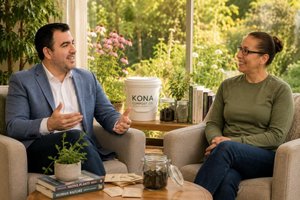
In a recent episode, I sat down with Heather Guidice of Kona Compost Co. to explore how localized environmental action can transform a suburban community. What stood out to me as a host was watching an entrepreneur build an entire ecosystem of sustainable businesses right here in Bucks County.
This conversation is designed to help local business owners, real estate professionals, and community advocates better understand how environmental stewardship directly drives local economic and community resilience.
Launching a Curbside Composting Service in Bucks County: The Core Business Model
Our conversation began with the origin story of Kona Compost Co., launched by Heather Guidice in 2019 after a 2018 corporate layoff. She noticed suburban residents wanted to divert food waste but lacked resources for composting. Her solution: a seamless residential pickup service, turning a chore into a premium utility.
Heather refined her idea before launching it. At her corporate job, she composted colleagues' fruit peels and shared the produce, realizing people wanted eco-friendly options but needed convenience. Penn State Extension's guide on home composting confirms Heather's observation: compost enriches soil, improves water retention, and yields healthier plants, benefiting homes for years. Her service brings these benefits to Bucks County.

Understanding how residential infrastructure connects to sustainable property management is a massive asset for modern local businesses. The Kona Compost services model, spearheaded by Heather Guidice of Kona Compost Co., offers two distinct tracks that keep resources directly within our neighborhoods:
The Curbside Program: Subscribing residents receive a five-gallon bucket for food scraps, which is collected weekly or bi-weekly. In the spring, that waste comes full circle as refined, nutrient-dense soil returned directly to the customers for their own lawns and gardens.
The Farmers Market Bucket Swap: Operating at the Wrightstown Farmers Market, this program allows residents outside typical driving routes to bring a full bucket and swap it for a clean one, creating a highly visible, community-centric point of contact.
The Hyper-Local Circular Waste Loop
| Program Type | Operational Mechanic | Direct Community Benefit | Property/Neighborhood Impact |
|---|---|---|---|
| Curbside Pickup | Automated weekly route collection of 5-gallon residential bins. | Annual soil give-back programs for residential gardening. | Reduces local municipal waste loads and improves residential topsoil health. |
| Farmers Market Swap | Bi-weekly physical collection points at community markets. | Expands geographical access to suburban and rural properties. | Drives foot traffic to local businesses while expanding sustainable infrastructure. |
When Heather first launched, she tested the concept by composting roughly 12,000 pounds of waste in her own backyard. Once she proved the model worked and outgrew what a pitchfork could handle, she moved operations to a farm — then scaled again to a network of processing partners, including one that redirects food scraps directly to a large flock of chickens and ducks. That circular logic — food waste becomes animal feed becomes healthy land — is the kind of thinking that separates a community composter from a traditional waste hauler.
Expanding Local Food Infrastructure Bucks County Through the Foodshed Alliance
Heather has built a multi-layered ecosystem of eco-stewardship through a curbside composting service Bucks County, the Bucks County Foodshed Alliance, Fill and Flourish, and the Bucks County Seed Share. The Bucks Beautiful organization recognized Kona Compost Co. for exactly this kind of community-driven sustainability work — and after sitting down with Heather, I understand completely why.
Only 5% of U.S. food waste is composted, yet it produces over half of landfill methane emissions. Heather tackles this locally with five-gallon buckets in Bucks County.
As a director for the Bucks County Foodshed Alliance, Heather focuses on supporting local farmers with grants, funding, and education programs.
Building strong local food infrastructure in Bucks County boosts neighborhood appeal and land value. Protecting agricultural assets and integrating them into suburban life creates a sought-after regional identity. For real estate professionals, a thriving foodshed network is now a key factor in assessing long-term livability.
Here's how Heather described the work happening right now:
"The Bucks County Foodshed Alliance is really focusing on our local foodshed — so our farmers and the soil and regenerative agriculture... They provide small farm grants for farmers. So if you needed help with your irrigation system or a piece of equipment or something along those lines, you're able to apply and receive a grant, potentially. They do a lot of events... We do farm tours, and so we highlight, we're highlighting a bunch of different farms all over Bucks... We're going to hang out with our farmers, learn a little bit more about their process. What are they growing? How are they going about it?... It's really a holistic organization looking at local community, local farmers, local stewardship, and how we can keep that story going and how we can support our local farmers."
— Heather Guidice, Director, Bucks County Foodshed Alliance
Actionable Takeaway for Local Real Estate Leaders
When helping clients assess the long-term value of a neighborhood, proximity to sustainable agricultural networks and robust local food systems is becoming a primary selling point. Aligning with foodshed initiatives positions you as an expert on modern regional development.
If you are currently advising buyers who are considering a more rural or agricultural setting, our full resource on the top things you should do before buying a rural home walks through how to evaluate land quality, local food access, and agricultural infrastructure as part of a thorough due diligence process.

Restoring Native Plants Ecosystem Stewardship to Protect Suburban Property Values
Heather highlighted the crucial role of native plants in ecosystem stewardship. While many see landscaping as purely aesthetic, Heather explained that non-native plants disrupt local food webs and confuse pollinators. She has planted 1,000 to 2,000 native plants on her half-acre, focusing on ecology over style. Native plants attract local insects, supporting birds and wildlife, whereas non-native ornamentals do not. Using herbicides and chemicals further harms habitats.
Dr. Doug Tallamy, a professor at the University of Delaware, co-founded the Homegrown National Park movement. His research shows that native birds and insects evolved with native plants, and losing these plants harms local biodiversity and human food systems. Heather referenced Tallamy's work directly in our conversation, and for good reason: his research transforms native plant stewardship from a lifestyle preference into a property management strategy with measurable outcomes.
To illustrate the balance needed for true property stewardship, Heather shared a framework explaining the systemic impact of land management choices:
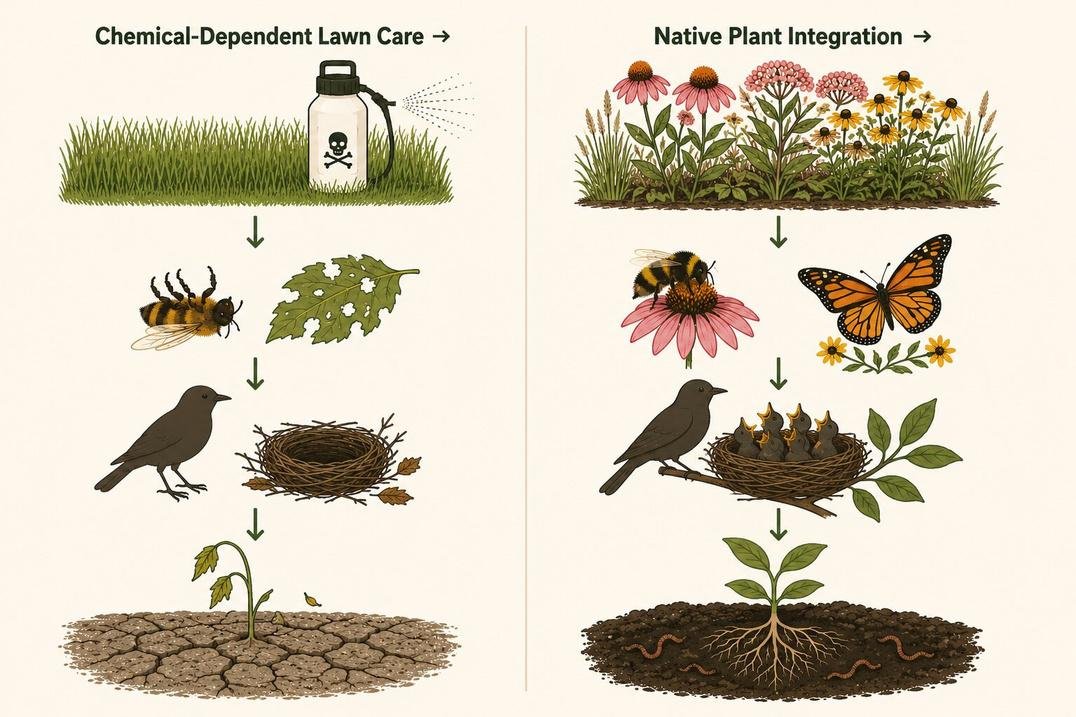
By planting indigenous varieties, property owners contribute directly to groundwater management, soil stabilization, and neighborhood ecological health. The EPA's own composting and soil health research confirms that healthy soil reduces stormwater runoff, mitigates drought risk, and improves the long-term resilience of land — all metrics that directly affect property owners, insurers, and prospective buyers.
Heather highlighted Bowman's Hill Wildflower Preserve in New Hope as a top resource for Bucks County homeowners. It’s the only accredited botanical museum in the country dedicated to native plants, it features over 700 of Pennsylvania's 2,000 native species across 134 acres of trails. Additionally, it has an on-site nursery that cultivates over 200 species from local seeds, making it a great resource for property restoration.
Thoughtful native landscaping is not just an ecological act. It is a curb appeal asset. If you are preparing to list a property and want to know which outdoor improvements move buyers, our breakdown of curb appeal projects to focus on if you want to sell your home this spring covers exactly which investments in your outdoor space create the strongest first impression in today's market.
Fueling Community Zero-Waste Initiatives via the Bucks County Seed Share
We wrapped up our deep dive into local infrastructure by exploring Heather's grassroots work with the Bucks County Seed Share, operating freely out of the Morrisville and Southampton Free Libraries. By providing free, open-pollinated seeds and organizing seasonal winter sowing and seed-packing volunteer events, this program removes the financial barriers to sustainable living options in Pennsylvania.
Heather co-founded the Seed Share with her friend Jean Kuhn, starting at the Morrisville Free Library before expanding to Southampton roughly two years later. At seed-packing nights — typically held each October at the Southampton Library — around 30 to 35 volunteers come together to pack thousands of seed envelopes ahead of the winter sowing season. It is one of those rare community events where people of all ages show up and leave more connected to the land and to each other than when they arrived.
Here's how Heather described it:
"The seed share, I believe we're in our fifth or sixth year... We offer open-pollinated seeds free of charge to community members. So the way that it works is that you would go and visit the drawers. You can take up to four packs of seeds per visit. If you're able to share them back to the seed share, great. And, if not, that's okay too. We offer winter sowing kits in the wintertime, and then we offer seed starting kits in the springtime. And it's a variety of things. So native plants, we have a really nice selection of those. But we also have vegetables, herbs, annuals, and some other perennials available for people to enjoy."
— Heather Guidice, Co-Founder, Bucks County Seed Share
What I find most compelling about the Seed Share model is how deliberately it was designed to remove friction. There are no fees, no membership requirements, and no obligation to contribute seeds back if you cannot. Accessibility is the entire point. At a time when grocery costs are climbing, and food security is becoming a real conversation across every income level, programs like this arm families with the tools to grow their own food — creating a layer of household resilience that no market condition can take away.
Minimizing Micro-Plastics Through Refill Delivery
Through her auxiliary brand, Fill and Flourish, Heather integrates community zero-waste initiatives right into her existing compost delivery routes. Customers order clean, non-toxic household products like dish soap in bulk glass jars, leaving empty containers out on their compost collection days to eliminate single-use plastic waste from the supply chain.
Heather founded Fill and Flourish to provide non-toxic, low-waste household products after failing to find them in major stores. By integrating this venture into her existing delivery system, she created an efficient model with minimal redundancy and packaging.
Customers can add products to their compost order for regular delivery, leaving empty jars for refill. Products are also available at farmers' markets, with pre-order options at Wrightstown and on-the-spot purchases at Yardley. This seamless integration into existing logistics showcases Heather's innovative approach.
How I Now Think Differently About Neighborhood Environmental Value
This conversation fundamentally shifted how I look at neighborhood infrastructure. As a host, I used to view composting and native planting as alternative lifestyle choices — appealing to a specific type of buyer, but not a universal driver of property value. Now, I see them as foundational metrics of a premium, resilient community.
Heather said something during this episode that has stayed with me:
"When I left the corporate world, it was one of those things that I wasn't feeling fulfilled, right? For me, it's just my cup is filled daily with doing all this. And especially even now, in the warmer months, that I can get outside and put my hands in the soil... Whatever we're doing now and what we've done prior doesn't work. And we are the only animal that lives on this planet that produces garbage that's not biodegradable, like truly biodegradable. And I feel like civilizations prior were the indigenous folks who thought more about how they are a part of the Earth rather than being the apex of everything, and saying, 'I'm the top of the food chain here, and this is how it's done, and I don't care about anything else.' I knew that something had to change."
— Heather Guidice, Kona Compost Co.
Heather isn't speaking theoretically. She built something tangible and replicable — a curbside composting service, a seed share program, a refill delivery network, and a foodshed directorship — all rooted in the same belief: that communities are stronger when they take care of their own land and each other.
When we introduce assets like a curbside composting service in Bucks County or prioritize native landscaping, we are actively improving the environmental security, topsoil viability, and community cohesion of our neighborhoods. The EPA's environmental research on compost confirms that composting food waste generates a 78% reduction in greenhouse gas emissions compared to landfilling — and applying finished compost to soil actively improves land health in ways that translate to stronger residential landscapes and more durable property values over time.

Moving forward, I will be assessing local property values not just by square footage and market comps, but by the strength of the hyper-local green infrastructure supporting them. Whether a buyer is weighing the tradeoffs between a single-family home versus a condo or evaluating a rural property with land to steward, the presence of a connected, functioning local ecosystem is now part of how I define premium in Bucks County.
If you are a local professional looking to understand how modern consumers think about green spaces, neighborhood value, and sustainable living options in Pennsylvania, learning from Heather Guidice at Kona Compost Co. provides the blueprint.
And if you are actively working to improve your home's overall environmental footprint before selling or buying, our guide on making your home more energy efficient with green home improvements is a strong complement to everything Heather is building in this region.
Want to hear my entire conversation with Heather Guidice about building local food infrastructure, native plant stewardship, and zero-waste business models in Bucks County? Listen to the full podcast episode.
FAQ
What exactly can be processed through a curbside composting service in Bucks County?
If it grows, it goes: fruits, veggies, coffee grounds, eggshells, plate scrapings, baked goods, and bread. Industrial partners process more materials than a backyard pile. The Kona Compost FAQ page has the full guidelines for what subscribers can include in their five-gallon buckets — including answers to the most common questions about what qualifies as compostable at the community scale.
Why are native plants so critical to local ecosystem stewardship and property maintenance?
Native plants support local wildlife and insects, unlike non-native ones. They create a self-sustaining landscape, preventing soil degradation and pest issues naturally. For Bucks County homeowners, Bowman's Hill Wildflower Preserve provides educational programs, guided walks, and a native plant nursery, making it an ideal starting point.
How does a residential bucket swap program work at local farmers markets?
Subscribers get a five-gallon bucket to fill with organic waste, which they exchange for a clean one at community hubs like the Wrightstown Farmers Market. Heather and the Kona Compost team operate the Wrightstown Farmers Market swap on the second and fourth Saturdays of each month.
Apply as a Guest Speaker
The layout of our communities is shifting. Modern neighborhoods demand smart resource management, green infrastructure, and sustainable utility pipelines.
If you are actively driving innovation within local ecosystems, environmental engineering, property development, or sustainable community leadership, we want to hear your story. Share your insights and inspire the next wave of regional leaders on our stage.