As a real estate agent, I know what it feels like to be constantly "on." Running between showings, managing contracts, and dealing with the rapid-fire demands of daily operations can lead to chronic stress that doesn’t just stay in your head. It manifests physically, showing up as a twitching eye, a racing heart, or a body that refuses to slow down no matter how hard you push it.
That is exactly what happened to June Hunt of Moon Dog Yoga Studio, years before she ever taught a single class. I sat down with June on the Bucksko Living podcast to talk about nervous system regulation, professional burnout, and what it actually takes to build a business around helping people breathe again.
Curious about this episode? Check out a quick preview of our conversation below.
Why Finding Balance Is the Ultimate Business Strategy
As a business owner juggling clients, family, and the nonstop pace of daily operations, I know what it feels like to watch the clock and feel my pulse spike. Hustle culture treats burnout like a badge of honor. So when I met June Hunt from Moon Dog Yoga Studio, I wanted to understand how someone climbs the corporate retail ladder at brands like The Gap and The Limited, earns an MBA in economics and business, and then walks away from all of it to teach people how to breathe.
June's story is not really about yoga poses. It is about a hard reset on what survival, entrepreneurship, and health actually mean. She did not leave corporate life on a whim. Her body forced the decision after stress turned into physical symptoms she could no longer explain away. You can trace June's full transition from corporate retail management to wellness entrepreneurship through her professional background, and it mirrors what a lot of us go through when we finally admit that recognizing the signs it is time for a major change is the first step toward building something better. Anyone working brutal hours, running on caffeine, and carrying constant professional pressure will recognize themselves in her story.
Watch the full conversation here:
How Stress Manifests and Forcing a Career Pivot
When June was climbing the corporate ladder, her daily fuel was coffee, cigarettes, long commutes, and constant travel. Some days her commute stretched an hour and a half each way. She smoked, she skipped meals, and she treated exhaustion as proof she was doing her job right.
Her eye started twitching, and she feared a brain tumor but ignored it due to work pressures. A doctor later revealed it was stress. This led her to yoga, where she struggled at first but remembered to "never give up, but always let go." Yoga became her anchor through a corporate sale, motherhood, and night shifts. The breaking point came after an overnight shift when she found her son and the rug covered in red marker, realizing something had to change.
That was the moment she decided to flip the script, the same instinct that pushes anyone through a major life transition, like settling into a new home or a new routine. During this transformation, she found herself embracing stress management for professionals, recognizing it as essential to maintaining balance in her high-pressure life.
This is not just a personal anecdote. It reflects a documented physiological pattern. According to the American Psychological Association's research on the body's stress response, chronic stress keeps muscles in a near-constant state of guardedness and strains nearly every major system in the body. June's path from that response back to calm is worth studying, because her own guide to nervous system regulation exercises breaks the science down into steps anyone can start today, and her broader philosophy on moving from a stress response back to rest and digest captures exactly what shifted for her.
| Corporate Burnout Signals | Sustainable Wellness Shifts |
|---|---|
| Shallow mouth breathing and constant adrenaline | Diaphragmatic nasal breathing that signals safety |
| Living on caffeine, skipping meals, high cortisol | Seasonal eating and Ayurvedic lifestyle habits |
| Reactive decision-making from a state of fear | Proactive nervous system regulation and mental clarity |
Mastering Nervous System Regulation Beyond the Poses

Most people think yoga is about flexibility or standing on one leg. June flipped that idea for me completely. True wellness starts with the health of the autonomic nervous system, which runs on two main settings: fight-or-flight, or rest-and-digest. June explained it this way:
"The definition of practicing yoga is maintaining a peaceful flow of mind. So technically, and especially not in the West, yoga is way more than just the postures where we go to class. It's about how do I maintain this peaceful flow of mind all the time? So if you do that or practice that, you're practicing yoga. So even though I've practiced since 1996... it's more about, if I know this makes me angry or I know this person annoys me, then how can I manage that to maintain this peace that once I leave them, I will not have, right? Or I'm driving to work, and I run a red light and I almost get into an accident, then I'm, like, hyperventilating. How can I get back to being calm? That's really practicing yoga. And then we have that agency, which we all need, to move ourselves from this state of stress to this state of rest and digest. And then we can think clearly. So then... we don't get ourselves in trouble by what shoots out of our mouth. We can take a step, take a couple breaths, and decide, 'Do I really wanna say that or do I wanna say that in a different way?'"
Your brain reacts similarly to physical threats and stress from emails, impacting long-term heart health. June's approach targets the nervous system by promoting nasal breathing instead of mouth breathing. Mouth breathing signals an emergency, keeping the body in a stress state, while slow, diaphragmatic nasal breathing conveys safety, allowing metabolic and digestive systems to function properly.
This lines up with clinical findings on diaphragmatic breathing and vagus nerve activation, which show that this simple technique reliably shifts the body out of fight-or-flight and into a calmer, more regulated state.
Building a Thriving Wellness Business from the Ground Up

Going from a corporate structure with built-in safety nets to launching a business from scratch is terrifying. When June opened her studio doors in 2010, the country was still climbing out of a brutal recession. Her own brother-in-law asked her who opens a business during a recession. She did, because she recognized a need nobody else in Upper Bucks was meeting.
Her very first class had thirteen people. Sixteen years later, she runs a staff of twenty, including instructors, massage therapists, and front-desk personnel. COVID nearly wiped out the industry, and June will tell you that was one of the hardest external stretches she has faced. But the harder lesson was internal. She told me:
"Honestly, living through COVID was tough. That was... It decimated this industry a lot. So like those external factors. But I would say the biggest thing personally was understanding that people come for a while and then they don't, right? And then they come again, and they don't. And that a lot of times it's not personal. Things are going on in their lives, right? And so many people come back after some time or this or that, and that you... I always stuck to, 'So you don't take it personal,' right? And as like, when you're running your own business... you can't be-- You can't worry, even though you do. You're trying to imagine, 'Okay, how am I gonna pay the rent this month? How am I gonna do this? How am I gonna do that?' You have to... It sounds so weird. You have to trust that you are doing your best, right? Again, you don't give up, but you let go. And so there are some ebbs and flows."
With a father in the industrial equipment business, June gained a strong business instinct rare among new studio owners. She understands financial dynamics, identifying cash cows and break-even offerings, similar to how brands profit from specific products. Her classes are designed to attract the right clientele, regardless of their direct financial impact.
Seeing an underserved market, June chose Quakertown for her studio, which had no local options and required a thirty-minute drive to the nearest studios. She noticed the transformation of the Lehigh Valley and saw similar growth potential in Upper Bucks.
Families were moving in from Lower Bucks, New York, and New Jersey chasing more affordable housing, and a genuine Quakertown wellness community was forming around them without anywhere to gather. That is the same calculation anyone weighs when considering the tradeoffs of putting down roots in a growing, more rural-leaning community instead of a denser, more expensive market.
It also explains why, on any given full moon, you can find her teaching an outdoor class in the park set entirely to Pink Floyd's Dark Side of the Moon, a fitting soundtrack for a studio named after an actual atmospheric phenomenon her husband once nicknamed her after.
Specializing in Yoga for Trauma Recovery and Veteran Support
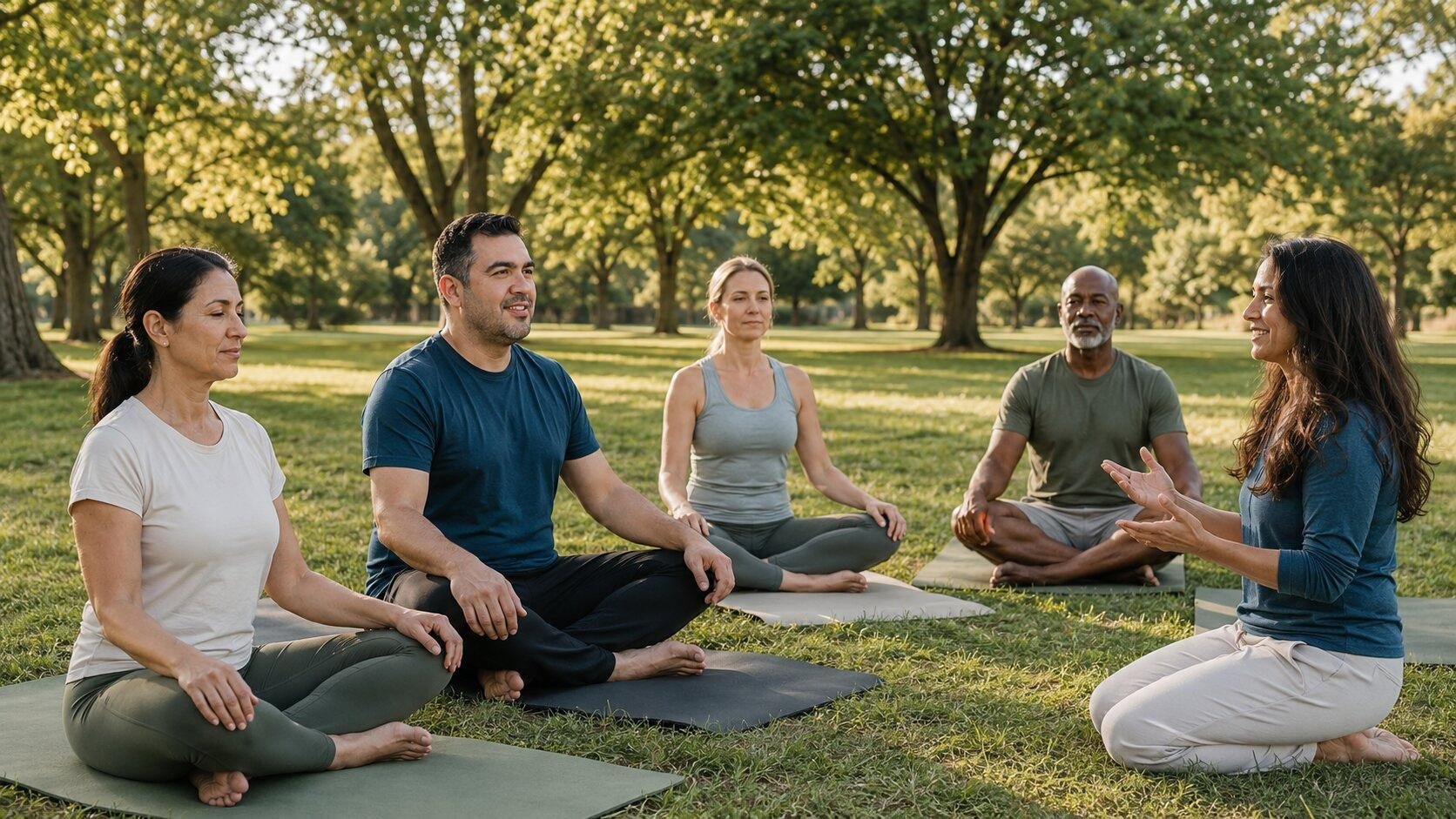
June's work goes beyond public classes at her studio; she serves on the board of Trauma and Resiliency Resources, contributing to Warrior Camps aimed at preventing veteran suicide. The program combines EMDR psychotherapy, equine therapy, and specialized yoga for trauma recovery, with narrative medicine and Native American medicine folded in over time. Warriors engage in a full week of immersive program work, with June providing individual sessions before group activities.
Most yoga instructors lack the training this work requires. June studied military morale and brain injuries before joining Warrior Camp. Standard poses are re-engineered; downward-facing dog is avoided due to skull pressure risks. With customized ten-minute daily routines for each veteran, the program reports a 99% success rate in preventing suicide.
This mirrors the growing body of clinical research on trauma-sensitive yoga for veterans with PTSD, which has found measurable reductions in PTSD symptoms and improved quality of life among participants.
June trains her own instructors in these modalities so they can safely take on private clients with a history of trauma or brain injury. Her studio's staff also includes massage therapists offering the kind of therapeutic bodywork that complements this work, from lymphatic and deep tissue massage to Reiki and prenatal care. She runs a second cause alongside TRR called Unite for Her, supporting people affected by breast, ovarian, and uterine cancer, using the same trauma-informed approach she developed for veterans.
Ayurvedic Lifestyle Habits That Round Out the Practice
June is an E-RYT 500 yoga instructor, Certified Vishoka Meditation Instructor, and Ayurvedic Health Counselor. She notes Ayurveda complements yoga by aligning habits and food with natural rhythms.
One of her core Ayurvedic lifestyle habits is leaving at least three hours between dinner and sleep, which gives digestion time to finish before the body shuts down for the night. Her own mornings start with hot water and lemon before anything else touches her stomach, followed by coffee she will freely admit is more habit than necessity at this point.
You can explore more of how she applies seasonal and elemental living principles day to day on her site.
How This Conversation Reshaped My Approach to Business Leadership
Sitting down with June made me look at my own daily routines differently. Business owners tend to wear stress like a badge of honor, running on empty and calling it the price of success. When I asked June whether corporate life or running her own studio felt more stressful, her answer surprised me:
"Running your own business [is more stressful]. Yeah. Because in the corporate world, like yes, you have numbers, right? And you have objectives and your goals... But let's be honest, if you don't make your goals... you still get paid. Maybe you just don't get a bonus. But there were times where I didn't pay myself 'cause I had to pay bills and that was more important. And, so I would say owning your own business because in the end, if something doesn't work, you're on the hook... Like when, whether it was the Limited corporation where I worked under a division of Victoria's Secret or The Gap, you have some products that you use just to bring them in, right? You're not making... Like in The Gap, we weren't making any money on the T-shirts. The money was on the jeans... So you have to know that like sometimes you have a class because that's when people can make it. It may be not a lot of people, but just enough people, right? So not every class is gonna blow the doors off, right? But if you wanna service everybody, so you have, what you call your cash cows and some that are just, breaking even."
Maintaining composure under pressure is crucial for making rational decisions in high-stakes situations, whether in a yoga studio or real estate. I've begun to focus on my breathing during challenges, work on my reaction time, view business fluctuations as normal, and understand that letting go of the uncontrollable isn’t giving up on what matters.
Want to hear my full conversation with June Hunt of Moon Dog Yoga Studio on how to reset your nervous system and beat professional burnout? Check out the complete podcast episode!
FAQ Section
What is the primary difference between a 200-hour and a 500-hour yoga certification?
A 200-hour certification is the basic requirement to teach yoga legally and safely. A 500-hour certification includes an extra 300 hours of specialized training in physiology, philosophy, and therapy. Instructors usually need to complete continuing education credits periodically to remain updated.
How do Ayurvedic lifestyle habits complement a regular yoga practice?
Ayurveda is considered the sister science of yoga, rooted in Eastern holistic medicine. It teaches you to sync your habits, food choices, and daily routine with your body's natural intelligence and the current season, such as leaving a three-hour window between dinner and sleep to support digestion. The National Center for Complementary and Integrative Health's overview of Ayurvedic medicine offers a deeper look at how this system approaches health holistically.
Why is mouth breathing harmful compared to nasal breathing during stressful situations?
Your nose is built for breathing, and your mouth is built for eating. Breathing through your mouth signals an emergency to your brain, keeping your autonomic nervous system locked in a chronic fight-or-flight state that disrupts heart health and digestion over time.
If you want to see June's full class schedule, pricing, and answers to more studio-specific questions, her studio's frequently asked questions page covers all of it. You can also follow along with her work on Instagram and Facebook under Moon Dog Yoga.
Apply to Be a Podcast Guest
The business landscape is constantly evolving, with changing market demands and increasing pressure. Professionals in various industries seek solutions for burnout, leadership fatigue, and operational stress.
If you are an industry leader, entrepreneur, or wellness professional actively solving real problems and helping your community thrive, I want to hear your story.
Follow the show on Instagram and Facebook, and connect with Anthony on LinkedIn.