Local history shapes a neighborhood’s atmosphere, its value, and the reasons people choose to stay. Imagine if the ground beneath your dream home held secrets of Revolutionary War outlaws. For residents of Bucks County, that question is more than hypothetical. It is a daily reality. This intriguing idea sits at the center of this Bucks Co Living episode.
Catch the snippet of this episode: 🏰 He Built a Castle Without Being an Architect?!
I recently sat down with Annie Halliday, Director of Library and Collections at the Mercer Museum and Fonthill Castle in Doylestown, to dig into the archives, the architecture, and the outlaws hiding in our county's past. What she shared changed how I look at every property line and stone farmhouse in the region.
Listen to the full conversation:
Why I Dived into the Archival History of Bucks County
I spend every single day looking at the modern market. Lot lines, list prices, and school districts. So I keep wondering about the bedrock under all of it. That curiosity is exactly why I walked into a historic library to record this one. I wanted the real story of Doylestown and the wider county.
Annie was recently promoted to Director of Library and Collections, which means she now oversees both the library archives and the museum's massive artifact collection. She grew up loving books and history, then spent about a decade as a professional stage manager in Philadelphia before earning her master's in library and archives. That theatrical background gives her a rare gift. She treats every object like a character with a story to tell.
Here is the part that matters for anyone working in this region. Understanding our shared roots is not a hobby. It is how you actually connect with the people who live here. The same instinct drives my approach to Bucks County real estate. You sell a place better when you understand its soul.
The Visionary Madness of the Henry Mercer Architectural History
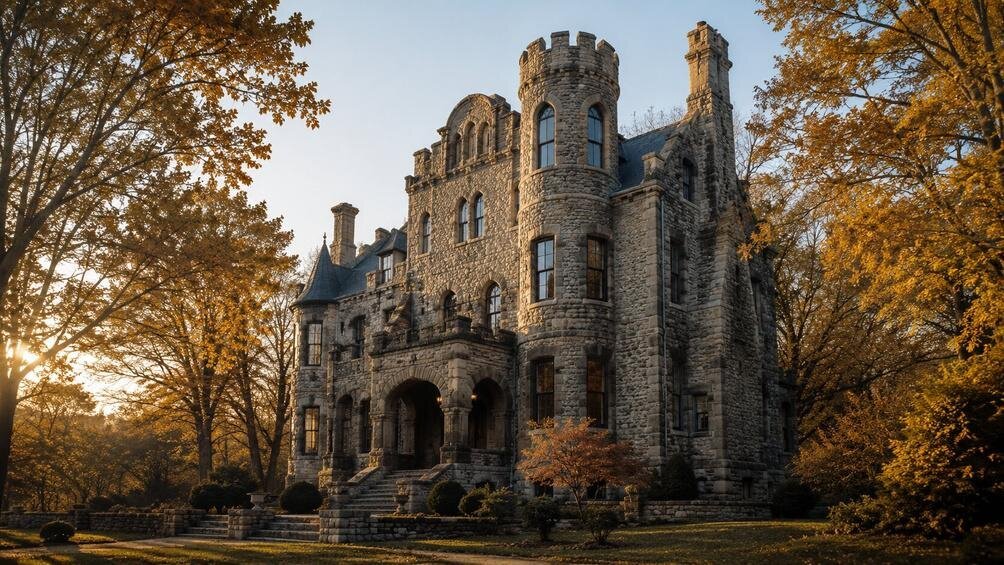
Drive past the concrete castle in Doylestown, and your jaw drops. Mine did the first time. The wild part is that Henry Mercer was entirely self-taught. He was never a trained architect. He built these structures without standard blueprints, working straight from hand-drawn sketches and notebooks to map out the staircases and vaulted ceilings.
That detail reframes everything about the Henry Mercer architectural history. Mercer saw that, at the peak of the Industrial Revolution, mass production was about to erase the marks of human craft. So he went on a mission. He salvaged pre-industrial tools, everyday utensils, and old building methods before they disappeared. You can trace that same Arts and Crafts conviction through his hand-pressed Moravian tile work, which still turns up in landmark buildings across the country.
Once you understand his obsession, the buildings stop being concrete and wood. They become monuments to foresight. Annie Halliday and her team at Mercer Museum and Fonthill Castle protect that legacy through the museum's object collection, where a single carved spoon can hold more history than a textbook.
Here is the contrast Mercer raced to preserve, laid out plainly:
| What He Looked At | Pre-Industrial Handcraft | Mass-Produced Industrial |
|---|---|---|
| How it was made | Shaped by hand by a craftsman over years of practice | Stamped out by machine in identical batches |
| The maker's signature | Unique tool marks, carved initials, and grip impressions worn in over time | Uniform finish with no individual trace |
| Everyday examples | A carved spoon, a hand-thrown pot, a carpenter's hand tool | Factory utensils and standardized parts |
| What it tells us | The story of the specific person who used it | Very little about any single human |
| Mercer's response | Salvaged and saved before it vanished | The force he worked to outrun |
Debunking the Myths of the Doan Gang Revolutionary War Outlaws
Every historic region has folklore. The value lies in separating the romance from the record. Around here, people talk about the Doan Gang Revolutionary War outlaws as if they were swashbuckling Robin Hood figures who robbed the rich to feed the poor.
The archives tell a grittier story. Through deep research for their current exhibition, Annie and her team confirmed these men as active British loyalists running real sabotage. They robbed tax collectors, ferried British prisoners, carried messages, and pulled off the Bucks County Treasury robbery of 1781 in Newtown. Recent archaeology has even tied that heist to a specific foundation on State Street, which turns campfire legend into documented fact.

Here is how Annie framed it in our conversation:
"Yeah, so the Doan Gang was a loyalist gang. They were pro-British during the American Revolution, which I know a lot of people are like, 'Why are you talking about loyalists during America 250 in 2026?' But they are these unbelievably fascinating characters that were real people who are from Bucks County, and they were tasked with sabotaging the American Revolution. They're robbing tax collectors. They're ferrying British prisoners of war. They're spying. They're delivering messages. They're big robberies, the Bucks County Treasury in 1781, which was located in Newtown. And they are just these unbelievable characters that are an interesting entry point to the conversation of the revolution. A big misunderstanding about the Doanes is that they were pacifist Quakers turned violent by the Revolution, and research has uncovered that they broke with Quakerism long before the Revolution came about. There's a story that Moses Doane crossed the Delaware and warned the Hessian commander, Colonel Rall, that George Washington was coming... unfortunately, that has never been substantiated. We always try to say the truth is just as interesting as the fiction... The treasure is the truth."
The Strategic Value of Local Truths
Accuracy carries weight. When you work with clients in historic towns like Newtown or Doylestown, knowing the true provenance of local events builds real authority. The verified 1781 Treasury robbery is a far better story to share than a rumor, and it proves our history holds plenty of organic drama without any fiction added on top.
The same logic applies to the ground itself. Before a buyer falls for a charming old property, they need the facts about the land it sits on. That is why I walk clients through practical homework, like what to know before buying a home in a flood-prone area. The truth about a place, past and present, always protects the people who live there.
Uncovering Home Value via Doylestown Historic Property Research
One of the busiest operations inside the archives is Doylestown historic property research. Homeowners arrive constantly, wanting clarity on their century-old houses. The library serves as the depository for Bucks County government records from the 1680s to the 1930s, and that includes deeds, surveys, and neighborhood maps.
The process is more rewarding than people expect. You start with the current owner and follow the title backward through each deed, noting who sold, who bought, and how the boundaries shifted. Old surveys often include a small sketch of the house and where it sat on the lot. Sometimes you even learn who the neighbors were. The Library of Congress lays out this same deed-by-deed method for tracing any old home, and it matches exactly what Annie's team does every week. Each layer adds a window into the people who cleared the land and lived inside those walls.
Annie put the appeal of this work better than I could:
"As far as property research goes, that is a huge component. That's a big attraction to coming and visiting us, which is property research. We have lots of people who buy a gorgeous stone house here in Bucks County or even something more recent and wanna learn more about when the house was built, who was the first person to live on it, and we're the depository for Bucks County government records, starting essentially from the formation of the county in the 1680s to the 1930s, and that includes deeds. And deeds can be very dry, boring, this many acres for this many dollars or pounds or whatever. But sometimes there's a survey of someone's property, and you can see like a little drawing of their house and where their house was located, and sometimes you'll get like their neighbors and who their neighbors were. And there are all these little great windows into what life was like in that time period, simply from something like a deed."

Modern Preservation and Preserving Local Community History
The biggest mindset shift for me came when Annie explained her team's current push. They call it "collecting the now." Preservation is not only about cataloging things from three centuries ago. It is an active responsibility to capture the moments we are living through right now.
During major events, people are usually just trying to survive, so the everyday objects get thrown out. By deliberately archiving contemporary items like vaccine vials, neighborhood concert videos, and handmade signs, the museum makes sure future generations will not find a blank space where our era should be. The Smithsonian made the same call when it preserved objects from the first U.S. COVID-19 vaccination effort, which tells you this instinct now runs through the whole field. If your own family or business wants a deeper trace of its place in that record, the museum's special library research services can help.
Annie explained why the long view matters so much:
"Something that is a big part of our work now is what we call collecting the now, because we are living in history all the time. During COVID, everyone was really interested in the 1918 flu pandemic... and people came to us and said, "What do you have related to that?' And we had nothing essential. And that's because they were trying to survive it... they unfortunately didn't really think 'Oh, we should be clocking what's happening and saving things.' So when COVID happened, we had vials that held the vaccine that people were getting. We asked for the vials from the Doylestown Hospital. We have letters and posters that children wrote to nurses thanking them for being on the front lines. We have a video that people took of outdoor concerts that are taking place in parking lots for nursing homes. So like all this really great stuff that felt crazily part of our lives at that time, and we were all obviously trying to survive this moment. Luckily, we were able to zoom out for a second and go, 'Wait a minute, we have to save this stuff,' 'cause in 50 years, I don't want somebody mad at me that I didn't, during my time here, that I didn't save anything from COVID. So it's like you really have to have that really long view of everything that's going on."
Avoiding Gaps in Our Shared Stories
When you look at your own neighborhood through a preservation lens, you start documenting change as it happens. A zoning shift. A historic storefront getting redeveloped. A community adapting to a new wave of residents. Capturing those milestones keeps the local story unbroken instead of leaving holes for the next generation to wonder about.
Buyers can do a version of this too, long before they ever reach the archives. There are plenty of online tools to research a potential neighborhood that let you watch how a community is evolving in real time. The habit is the same as the one in the museum models. Pay attention, and write it down before it is gone.
How This Architectural Exploration Reshaped My Market Perspective
Sitting in that concrete library changed how I see our geography. I used to think of history as something static, locked under glass for school field trips. Now I see it as a moving wheel where human behaviors and small frustrations keep repeating. People in the 1700s griped about the weather and money owed to them, the same way we do.
That reframe sticks with me in this business. Every property, every tract of land, every development carries a human story and a set of real-world conditions. The smart move is to learn both. Researching a home's past and its risks go hand in hand, which is the same reason I tell clients what to check if they are buying in a wildfire-prone area when their search takes them beyond our region. Old tiles, original deed marks, and modern hazard maps all point to the same thing. These are the timeless human experiences that make our communities worth living in.
Want to hear my entire conversation with Annie Halliday of the Mercer Museum and Fonthill Castle about the Doan Gang, Henry Mercer's concrete castles, and how to trace your own home's history through old deeds? Listen to our podcast episode for all the stories we couldn't fit in this post.
Frequently Asked Questions
How can residents use Bucks County historical records to research their own homes?
Residents can visit the library archives to access government records, original deeds, and property surveys dating from the 1680s to the 1930s. These documents often include plot maps, details on neighboring properties, and descriptions of original structures that help establish an authentic timeline for a home.
What makes Henry Mercer tile installations so significant across the country?
Henry Mercer was a master ceramicist whose hand-crafted tiles from the Moravian Pottery and Tile Works earned national fame. His detailed installations appear in landmark buildings across the United States, including the largest art installation inside the Pennsylvania State Capitol building in Harrisburg.
Where can I see the latest artifacts discovered about the Doan Gang?
The Mercer Museum features a dedicated exhibition titled "The Doan Gang: Outlaws of the Revolution." It showcases real artifacts, family archives, and verified documentation that separates the historical facts from the regional folklore surrounding their loyalist activities.
Share Your Story on the Guest on Bucks Co Living
Local history keeps evolving. Neighborhood identities are shifting, and historic properties are finding new life in modern markets.
If you are involved in this regional ecosystem—whether you're managing historic preservation or addressing real challenges in construction, property development, or local curation—I would love to hear your story. Sharing the hidden stories behind our historic properties is an excellent way to help others understand why preserving local heritage fosters stronger, more connected communities.